
Why AI Voice Agents Are Replacing IVR Systems (And How to Make the Switch)
Learn why 88% of customers hate IVR menus and how AI voice agents solve the problem. Real case studies, cost comparisons, and a migration guide.
- 88% of customers say IVR systems aren’t intelligent enough—and 60% immediately try to “zero out” to reach a human
- AI voice agents can handle natural conversations, reducing resolution times from 11 minutes to under 2 minutes
- Companies like Klarna saw $40M in profit improvement after replacing traditional support with AI
- True speech-to-speech AI (like Leadlock) responds in 100ms with no awkward pauses—unlike orchestration layers with 1-3 second delays
“Press 1 for sales. Press 2 for support. Press 3 to repeat this menu.”
Everyone hates this. Customers, businesses, even the people who build IVR systems. Yet somehow, these outdated phone trees are still the default for most businesses.
The data tells the story: according to eGain’s IVR Customer Experience Survey, 88% of customers say IVR systems aren’t intelligent enough to help them. Sixty percent try to “zero out” immediately to reach a human. And 67% have spent more than 5 minutes wrestling with IVR menus just trying to get an answer.
But here’s what’s changed: AI voice agents can now handle natural conversations without menus, without button presses, and without making your customers want to throw their phones across the room. This guide shows you why the switch is happening, what the results look like, and how to do it right.
Why Traditional IVR Systems Are Failing
Let’s be honest about what IVR actually is: a system designed in the 1970s to route calls using touch-tone buttons. Fifty years later, most IVR implementations are fundamentally the same—just with slightly better voice prompts.
The problem isn’t that IVR was a bad idea. It was brilliant for its time. The problem is that customer expectations have evolved while IVR has barely changed.
What customers experience with IVR:
- Limited options - As Cognigy points out, “There are only ten numbers on the phone. You can’t press 11, 12, or 13 for any more options.”
- No context awareness - Call back about the same issue? Start from scratch.
- Single-intent handling - Want to check your balance AND schedule a payment? That’s two separate call paths.
- Zero personalization - Every caller gets the same robotic menu regardless of history.
According to Replicant’s research, more than 60% of consumers feel IVR technology makes for a poor customer experience, with 64% reporting negative emotions like frustration when encountering these systems.
Pro Tip: If your IVR abandonment rate is above 5%, you’re losing customers before they even talk to anyone. Most businesses don’t track this metric—but they should.
How AI Voice Agents Actually Work (The Technical Difference)
Not all “AI” voice solutions are created equal. There are two fundamentally different architectures, and the difference matters.
The Orchestration Layer Approach (Most Platforms)
Most voice AI platforms—Vapi, Retell, Bland, Synthflow—work like this:
Customer speaks → Speech-to-Text (Deepgram) → LLM (OpenAI) → Text-to-Speech (ElevenLabs) → Customer hearsThat’s four separate systems. Four API calls. Four providers taking their cut. Each hop adds 200-500ms of latency.
Result: 1-3 second delays between when the customer finishes speaking and when the AI responds. It feels like talking to someone with a bad connection—awkward pauses that break the flow of natural conversation.
True Speech-to-Speech (Leadlock’s Approach)
Customer speaks → Native Multimodal Model → Customer hearsNo transcription. No text conversion. Just audio in, audio out. 100 milliseconds. The conversation feels human because it actually flows like one.
Here’s the thing: you can clone the sexiest voice alive with ElevenLabs. But if there’s a 3-second delay before every response? All the magic is gone. Latency is the killer.
| Approach | Latency | Cost | Feel |
|---|---|---|---|
| Traditional IVR | Instant (but limited) | Low | Robotic, frustrating |
| Orchestration Layer AI | 1-3 seconds | $0.13-0.31/min | AI lag, awkward |
| True Speech-to-Speech | 100ms | $0.10/min | Human-like |
Real Companies, Real Results
This isn’t theoretical. Companies are already making the switch and seeing dramatic improvements.
Klarna: 2.3 Million Conversations in Month One
The fintech giant deployed an AI assistant that handled two-thirds of all customer service conversations in its first month.
The results:
- 2.3 million conversations handled by AI
- Resolution time dropped from 11 minutes to under 2 minutes
- Equivalent work of 700 full-time agents
- 25% drop in repeat inquiries (better first-call resolution)
- Estimated $40 million profit improvement in 2024
Customer satisfaction? On par with human agents.
DoorDash: Hundreds of Thousands of Daily Calls
DoorDash replaced traditional IVR with an AI voice agent built on Amazon Bedrock to handle Dasher (delivery driver) support.
The results:
- Handles hundreds of thousands of support calls daily
- Thousands fewer escalations to live agents per day
- Response latency of 2.5 seconds or less
- Production-ready in just 2 months
Why voice specifically? Dashers prefer voice support while driving—they can’t type. The AI handles questions naturally without making drivers navigate menus.
Purolator: 98% Voice Accuracy
The Canadian logistics company achieved remarkable containment rates after moving to conversational AI:
- 98% voice accuracy
- 95% chat containment rate (resolved without human agent)
That 95% containment means only 5% of calls need a human—compared to IVR systems that mostly just route calls to agents anyway.
The Cost Equation: Why AI Actually Makes Sense Now
Let’s talk money. Traditional arguments against AI were about cost. That’s changed.
Traditional IVR:
- Low per-call cost (just infrastructure)
- But low deflection rate (calls still go to agents)
- Hidden cost: frustrated customers who leave
Orchestration Layer AI (Vapi, Retell, etc.):
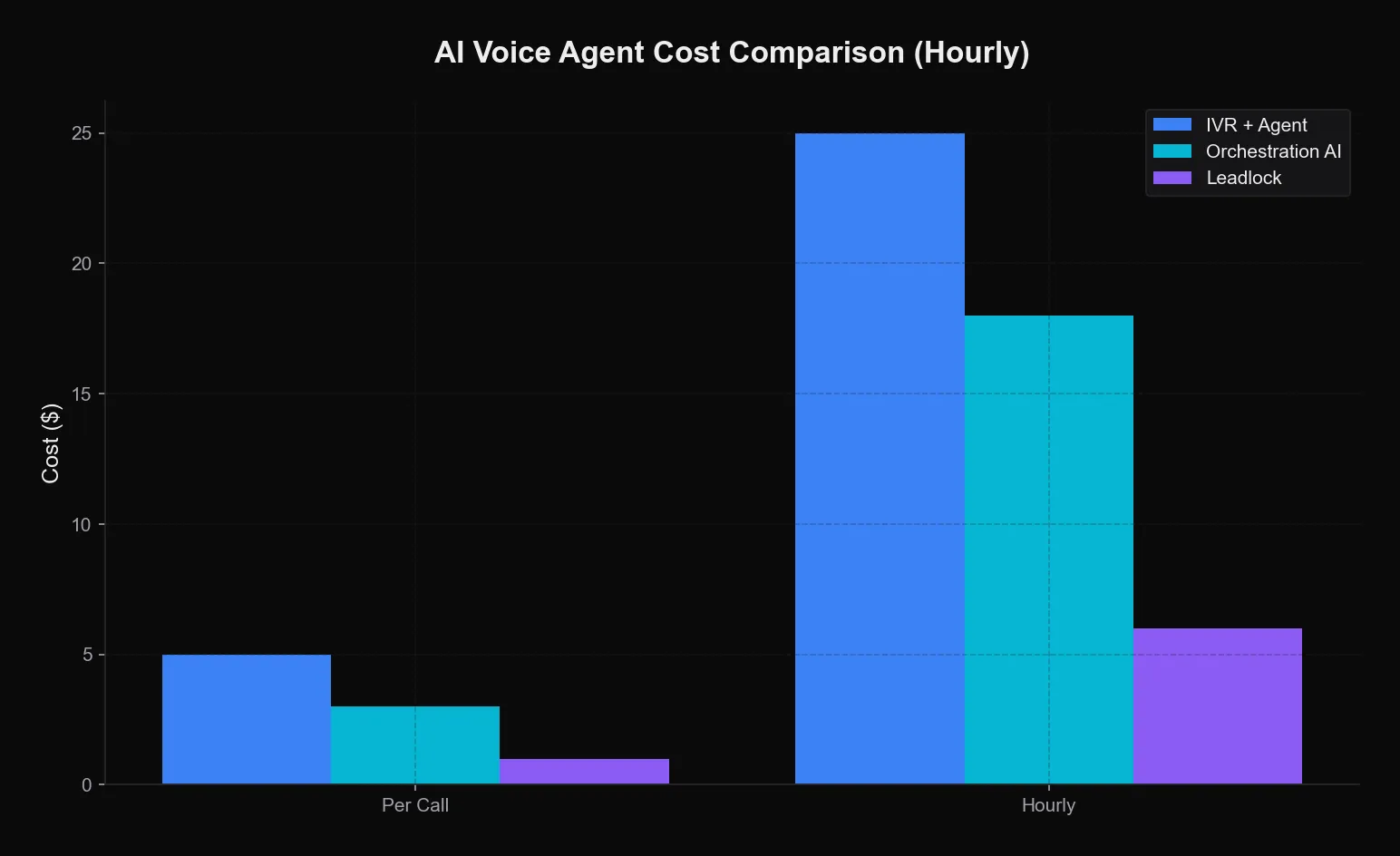
- Advertised: $0.05-0.09/minute
- Real cost: $0.13-0.31/minute (once you add STT + LLM + TTS + telephony)
- At $0.25/minute, that’s $15/hour
- At $0.50/minute, that’s $30/hour—at which point, just hire a human
True Speech-to-Speech AI (Leadlock):
- $0.10/minute flat
- That’s $6/hour for 24/7 coverage
- No stacked API costs. No surprise bills.
The math is simple. If you’re paying more than $15/hour for AI that sounds robotic and has awkward pauses, something’s wrong. True speech-to-speech changes the economics entirely.
The Industry Is Moving Fast
This isn’t a future prediction—it’s happening now. According to Gartner’s December 2024 survey:
- 85% of customer service leaders will explore or pilot customer-facing conversational GenAI in 2025
- 75%+ feel pressure from executive leadership to implement GenAI
- 44% are exploring voicebots, 11% piloting, 5% already deployed
The question isn’t whether AI voice agents will replace IVR. It’s whether you’ll be early or late to the transition.
How to Make the Switch (Without Breaking Everything)
You don’t have to rip out your entire phone system overnight. Here’s a practical migration path:
Phase 1: Start with One Use Case
Pick your highest-volume, most repetitive call type:
- Appointment confirmations and reminders
- Basic status inquiries
- After-hours call handling
- FAQ responses
Why start small: You’ll learn what works for your customers without betting the farm.
Phase 2: Run in Parallel
Keep your IVR active for complex scenarios while AI handles the simple stuff:
- AI answers first
- Handles what it can
- Routes to IVR/human for complex issues
- Gradually expand AI capabilities
Phase 3: Flip the Default
Once AI is handling 70%+ of calls successfully:
- Make AI the primary path
- Keep IVR as fallback only
- Eventually phase out IVR entirely
What to Look for in a Platform
Not all AI voice platforms are equal. Here’s what matters:
| Feature | Why It Matters |
|---|---|
| True speech-to-speech | 100ms latency vs 1-3 second delays |
| Transparent pricing | $0.10/min flat vs $0.25+/min hidden costs |
| Quick setup | Live in 5 minutes vs weeks of configuration |
| Calendar integration | Book appointments automatically |
| CRM integration | Log calls, update records |
| No SIP trunking | Avoid telephony complexity |
“For agencies grinding it out with GHL, the GoHighLevel integration matters. One-click connection versus days of configuration makes a real difference when you’re managing multiple clients.”
Common Objections (And Reality Checks)
“AI can’t handle complex conversations.”
It can now. Natural language understanding has crossed the threshold where AI handles nuanced, multi-intent conversations. The case studies above prove it.
“Our customers prefer humans.”
Research shows customers prefer getting their problem solved quickly. If AI does that better than IVR + hold time + agent, they’re happy. Klarna’s satisfaction scores matched human agents.
“It’s too expensive.”
At $0.10/minute ($6/hour), AI is cheaper than any human alternative. The question is whether you’re looking at true speech-to-speech or expensive orchestration layers.
“We’ve tried chatbots and they failed.”
Voice AI is not chatbots. Different technology, different experience, different results. Text-based chatbots have a 40% failure rate. Modern voice AI has 95%+ containment.
“Our industry is too specialized.”
Custom prompting handles specialized knowledge. Goal-oriented prompting (like Leadlock offers) lets you tell the AI what to accomplish without technical configuration.
The Bottom Line
IVR was brilliant technology for 1975. It’s not brilliant for 2026.
Your customers are spending 5+ minutes fighting with menus. Sixty percent try to bypass your automation entirely. And 88% say your system isn’t smart enough to help them.
AI voice agents fix this. They have natural conversations, resolve issues in minutes instead of being stuck in menu loops, and work 24/7 without breaks or bad days.
The companies making the switch are seeing transformational results: Klarna’s $40M profit improvement, DoorDash’s thousands of fewer escalations daily, Purolator’s 95% containment rate.
But architecture matters. Orchestration layers that stitch together STT→LLM→TTS create awkward pauses and stacked costs. True speech-to-speech eliminates both.
Ready to stop torturing your customers with “press 1 for sales”? Leadlock gets your AI voice agent live in under 5 minutes—with 100ms latency, $0.10/minute pricing, and instant GoHighLevel integration. Start your free trial.
Ready to Never Miss a Call Again?
Join hundreds of businesses using Leadlock's AI voice agents to capture more leads and grow revenue 24/7.
Start Free Trial