
Healthcare call centers lose 34% of patients to hold times. AI automation fixes it. See real ROI data, case studies, and how Leadlock compares to Vapi, Retell & Synthflow.
- 30% of patients abandon healthcare calls after 1 minute on hold - AI voice automation eliminates wait times entirely and handles scheduling and routine calls 24/7.
- Traditional AI voice platforms (Vapi, Retell, Synthflow) use a 3-step STT→LLM→TTS pipeline that adds a delay at every hop and true costs of $0.13–$0.33/min; Leadlock’s audio-to-audio architecture replies in about 300ms on Grok, from $0.12/min all-in.
- Real healthcare deployments show 17–68% self-service rate improvements, 2,000+ calls/month automated, and ROI of 3.5x or more within the first year.
- Only 19% of medical practices currently use AI for patient communication - early adopters are capturing significant scheduling efficiency and patient retention advantages right now.
Healthcare call centers are in crisis. The average patient waits over 4 minutes on hold - against an industry benchmark of 50 seconds. One in three patients abandons their call before anyone picks up. And when someone does answer, only half of issues get resolved on the first attempt. The system is broken, and patients are leaving because of it.
AI call center automation is the fix - and forward-thinking healthcare organizations are already deploying it. Platforms like Leadlock AI make it possible to handle the calls that carry no patient health information (booking requests, overflow, hours, directions and pricing questions) with a voice agent that replies in about 300ms on Grok, priced all-in per minute. Leadlock is not HIPAA compliant and signs no BAA, so intake, insurance and anything clinical belong with a vendor that signs one. No hold queues. No burnout. No dropped calls.
This isn’t a future-state scenario. Healthcare AI spending hit $1.4 billion in 2025, nearly tripling year-over-year. Patient engagement automation alone is a $100M+ market growing 20x annually. The question isn’t whether your practice should automate - it’s whether you can afford to wait.
Why Healthcare Call Centers Are Failing Patients
The numbers are brutal. According to Commure’s 2025 analysis:
- Average hold times exceed 4 minutes (the HFMA benchmark is 50 seconds)
- 30% of patients abandon calls if wait time exceeds 1 minute
- Only 50% of issues are resolved on the first attempt
- Call centers run at roughly 60% capacity
- Labor accounts for nearly half of total call center operating costs
The downstream effect is devastating. 89% of patients cite care navigation challenges - scheduling difficulty, long waits, access barriers - as the primary reason they switch providers. 34% have given up on booking an appointment entirely because they couldn’t get through.
That’s not a staffing problem. That’s a structural problem. And throwing more headcount at it doesn’t scale.
The Real Cost of a Broken Phone System
Healthcare staff spend up to 80% of call time on manual data compilation - looking up records, verifying insurance, confirming appointment slots. That’s not care. That’s administrative drag that AI handles in seconds.
For a medical group handling 360,000 calls per year, Relatient’s ROI modeling shows that automating just 60% of routine calls saves roughly $178,848 annually. A healthcare customer service rep costs an average of $20.70/hour (~$43,000/year fully loaded). Every agent-hour you eliminate is money returned to care delivery.
And adoption is accelerating. 43% of medical groups adopted or expanded AI tools in 2024 - nearly doubling from the prior year. The competitive gap between practices that automate and those that don’t is widening fast.
What AI Call Center Automation Does in Healthcare
The five highest-ROI automation targets for healthcare call centers are:
- Appointment scheduling, confirmation, and rescheduling - handles the majority of inbound volume with zero hold time
- Prior authorization intake - collects required data, routes to appropriate workflows
- Insurance verification - confirms coverage, copays, and eligibility before visits
- Triage routing - determines urgency and connects patients to the right resource
- Post-visit follow-up outreach - discharge instructions, medication reminders, satisfaction surveys
Each of these tasks follows a predictable script. They don’t require clinical judgment. They just require availability at scale - which is exactly what AI voice agents deliver.
Pro Tip: Start with appointment confirmations and reschedules. This single use case typically accounts for 20–30% of inbound call volume and has the fastest path to measurable ROI. Mississippi Sports Medicine saved 2,000 calls/month and 1,340+ staff hours per year with this one workflow alone.
The Orchestration Problem That’s Costing You More Than You Think
Most AI voice platforms advertise low per-minute rates but hide the real architecture cost. Here’s what’s actually happening under the hood with Vapi, Retell, Synthflow, Bland, and Assistable:
Traditional AI voice pipeline: Speech-to-Text (API call 1) → LLM (API call 2) → Text-to-Speech (API call 3)
That’s three separate API calls per conversational turn. The result: a delay at every hop between when a patient speaks and when the agent responds. In a real phone conversation, that pause feels broken. Patients hang up. Staff get escalation calls. The whole value proposition collapses.
Leadlock’s architecture: Audio In → Native Multimodal Model → Audio Out
One step. Leadlock agents reply in about a third of a second on Grok (median of 461 live turns, measured September 2026). The conversation flows naturally because it actually is natural - the model processes audio directly without converting to text first and back again.
The pricing deception runs deeper. Competitors advertise $0.05–0.09/minute. But when you add:
- STT API costs
- LLM inference costs
- TTS API costs
- Telephony/SIP trunking
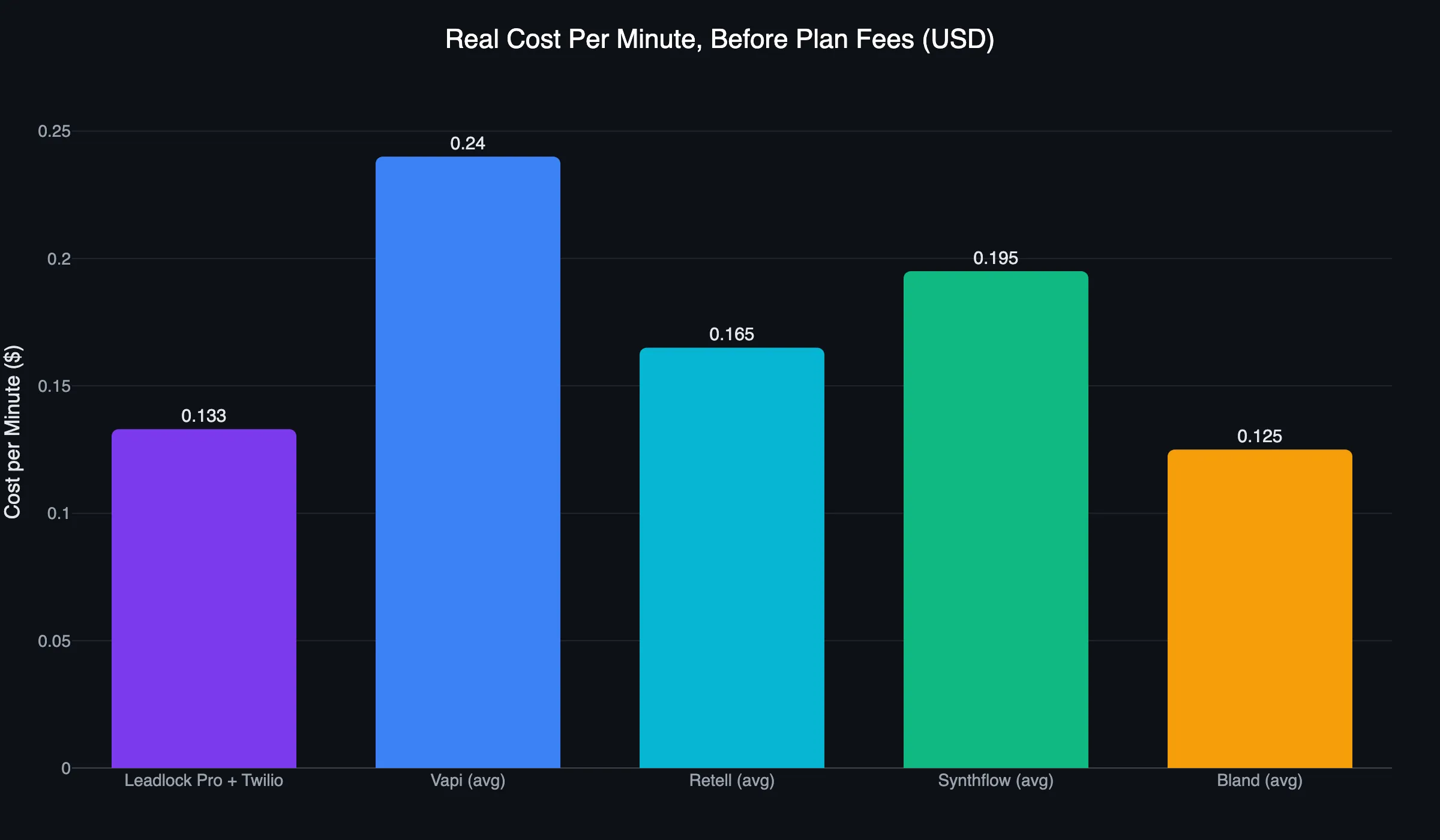
…the real cost lands between $0.13–$0.33/min. Leadlock starts from $0.12/minute all-in with Gemini. No hidden fees. No SIP trunking required.
Healthcare AI Voice Platform Comparison
| Platform | Architecture | Latency | True All-In Cost | Setup Time | GHL Native |
|---|---|---|---|---|---|
| Leadlock | Audio → Multimodal → Audio | ~300ms reply (Grok, median) | from $0.12/min | < 5 min | Yes |
| Vapi | STT → LLM → TTS | Varies by stack | $0.15–0.33/min | Hours | No |
| Retell | STT → LLM → TTS | Varies by stack | $0.13–0.20/min | Hours | No |
| Synthflow | STT → LLM → TTS | Varies by stack | $0.15–0.24/min | Hours | No |
| Bland | STT → LLM → TTS | Varies by stack | $0.11–0.14/min bundled | Hours | No |
Retell does offer HIPAA-compliant agents with EHR integrations (Epic, Dentrix, eClinicalWorks) and has published results showing 45–50% call resolution without human agents. Synthflow has documented 60% scheduling efficiency gains in healthcare deployments. Both are credible options - but for calls that carry no patient health information, neither matches Leadlock’s reply speed on Grok. For a broader view of the landscape, see our roundups of the best Bland AI alternatives and best Assistable alternatives for 2026, or our guide to the best AI voice agent platforms for small business, our ranked list of AI receptionist software for 24/7 call answering, our roundup of the best AI phone answering services for growing businesses, our comparison of white-label AI voice agent platforms for agencies, our ranked guide to the best AI appointment booking software, our ranking of the best speech-to-speech AI platforms for true multimodal voice agents, our real pricing breakdown across AI voice agent platforms, our guide to AI voice agents for real estate lead follow-up and showing bookings, our dedicated guide to AI voice agents for dental offices, our guide to AI voice agents for law firm client intake and appointment scheduling, our guide to AI voice agents for gyms and fitness studios, or our guide to AI voice agents for financial advisors.
Real-World Results: What Healthcare Practices Are Seeing
The case studies are consistent across organization size:
Virtua Health deployed voice AI across a 200,000+ call annual volume. Results in year one:
- Saved 4,395 agent hours in month one (equivalent to 8 FTEs)
- Reduced patient access call volume by 17%
- Grew self-service rate from 51% to 68%
- Net Promoter Score jumped from 20 to 55
- Patient “Ease of Scheduling” improved 29%
- Achieved 3.5x anticipated ROI
Medbelle (UK/Germany personal healthcare provider) deployed AI for inbound scheduling via Synthflow. Results:
- 2.5x increase in qualified appointments booked
- 60% improvement in scheduling efficiency
- 30% reduction in no-show rates
Mississippi Sports Medicine & Orthopaedic Center automated appointment confirmations and reschedules:
- AI now handles ~20% of total inbound call volume
- Saves 2,000 calls/month and 112 staff hours/month
- Equivalent to more than one full-time position avoided (~$43,000+/year)
The pattern is clear: even modest automation of routine call volume delivers significant, measurable ROI within the first few months.
The Market Opportunity - And Why Most Practices Are Still Behind
Here’s the paradox: despite all this data, only 19% of medical practices currently use AI chatbots or virtual assistants for patient communication, according to a 2025 MGMA poll of 375 practices. That means 81% of practices are still handling everything manually.
The conversational AI in healthcare market was valued at $13.68 billion in 2024 and is projected to reach $106.67 billion by 2033 - a 25.71% CAGR. The window to get ahead of competitors and establish AI-augmented patient communication is wide open.
First movers capture the scheduling efficiency gains. Later movers scramble to catch up while losing patients to practices that answer the phone.
How to Deploy Healthcare AI Voice Automation (Without the Complexity)
Most healthcare organizations assume AI voice requires months of implementation, custom SIP trunking, and deep technical resources. That assumption is wrong - at least with the right platform.
Here’s what a practical rollout looks like:
- Identify your highest-volume routine call types - start with scheduling, confirmations, and basic FAQs
- Choose a platform that fits the data on the call - any call that carries patient health information needs a HIPAA-compliant vendor that signs a BAA
- Configure your voice agent - set greeting, call routing logic, escalation triggers
- Connect your phone number - no SIP trunking needed on Leadlock; live in under 5 minutes
- Test with a subset of call volume before full rollout
- Measure: calls handled, handle time, abandonment rate, patient satisfaction
- Expand to additional use cases - prior auth intake, post-visit follow-up outreach, insurance verification (these carry patient health information, so they need a HIPAA-compliant vendor that signs a BAA, not Leadlock)
For agencies managing multiple healthcare clients, Leadlock’s native GoHighLevel integration means you can deploy and manage AI voice agents across practices from a single dashboard, limited to calls with no patient health information, since Leadlock is not HIPAA compliant and signs no BAA.
What HIPAA Compliance Actually Requires
Any AI voice platform processing protected health information (PHI) must be HIPAA-compliant. That means:
- Business Associate Agreements (BAAs) in place
- Encrypted data transmission and storage
- Access controls and audit logging
- No PHI retention beyond what’s operationally necessary
Leadlock is not HIPAA compliant and does not sign a BAA, so a practice that needs patient health information on the call should use a vendor that signs one. Leadlock fits calls that carry no patient health information: after-hours booking requests, overflow, hours, directions and pricing FAQs. When evaluating any platform, require a signed BAA and confirm how PHI is handled during transcription, storage, and model inference. Don’t assume compliance - verify it.
Frequently Asked Questions
Q: How much does it cost to add AI voice automation to a healthcare call center?
Pricing depends on the platform and usage model. Leadlock AI runs from $0.12/min all-in on the Pro plan with Gemini or Grok ($0.18/min on Starter), which covers the full audio-to-audio pipeline - no separate STT, LLM, or TTS charges stacked on top. Competitors like Vapi, Retell, and Synthflow typically land at $0.13–$0.33/min in true costs once all components are counted.
Q: Is AI voice automation HIPAA-compliant for patient scheduling calls?
HIPAA compliance is achievable with AI voice systems, but the platform and deployment configuration matter. You need a vendor willing to sign a Business Associate Agreement (BAA), data processed and stored in compliant infrastructure, and call recordings handled according to your retention policy. Always verify BAA availability and ask specifically where audio and transcript data is stored before deployment.
Q: What is TTFA and why does it matter for patients calling a medical practice?
TTFA stands for Time to First Audio - the delay between when a patient stops speaking and when the AI begins responding. On traditional STT-to-LLM-to-TTS pipelines like those used by Vapi or Synthflow, each extra hop adds to that gap, which can sound robotic and frustrating in a phone conversation. Leadlock’s audio-to-audio architecture skips those hops, and its agents reply in about 300ms on Grok, which keeps the conversation sounding natural. We still recommend the agent says it is an AI assistant at the start of the call.
Q: Can an AI voice agent actually handle insurance verification questions, or just scheduling?
Modern AI voice agents can handle a broader set of tasks than scheduling alone. Insurance eligibility checks, copay questions, referral status, and pre-authorization follow-ups are all within scope when the agent is connected to your payer APIs or a middleware layer. The limitation is usually integration depth, not the AI itself - how much data the agent can pull in real time determines how far it can go before escalating to a human. Insurance questions carry patient health information, so they need a HIPAA-compliant vendor that signs a BAA; Leadlock does not.
Q: Which AI voice model works best for healthcare calls - OpenAI Realtime, Gemini Live, or Grok?
All three are capable of real-time, low-latency voice conversation, but they differ in cost, latency profile, and availability. Gemini Live and OpenAI Realtime are the most widely deployed in production healthcare environments today. Grok is newer to the voice space. The right choice depends on your volume, latency requirements, and whether your platform - like Leadlock - abstracts model selection so you can switch without rebuilding the integration.
Ready to stop losing patients to hold queues? Leadlock delivers true speech-to-speech AI voice agents from $0.12/minute all-in for the healthcare calls that carry no patient health information: booking requests, overflow, hours, directions and pricing questions. Leadlock is not HIPAA compliant and signs no BAA. Book a 15-minute call with Dan.
See It Book a Real Job
Voice agents that book into ServiceTitan and GoHighLevel, live today for home-service brands. Book 15 minutes with Dan, or start a 7-day trial from the pricing page.
Book a 15-minute call with Dan

